
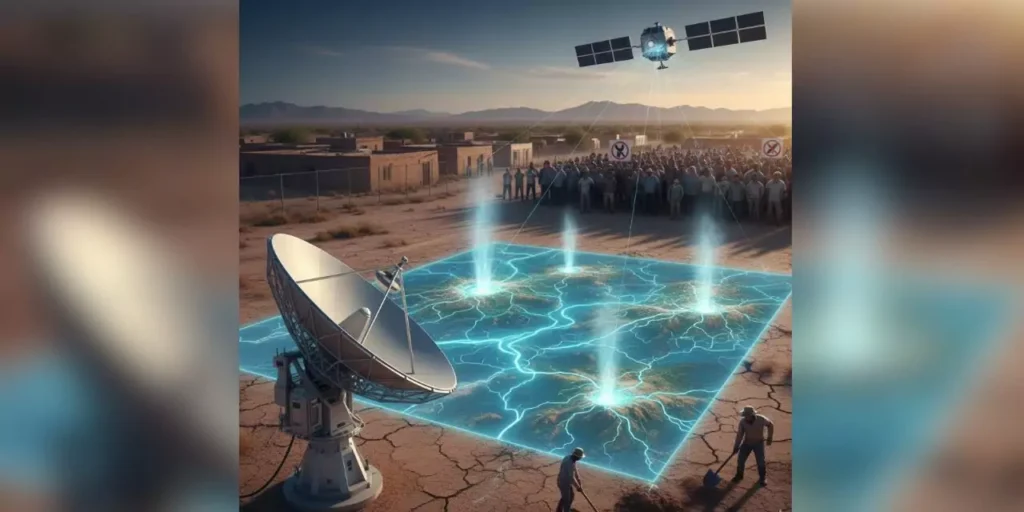
In the midst of the growing global water crisis, part of the solution is not found in new dams or deeper wells, but more than 600 kilometers high. A satellite system, originally developed to search for water on Mars, is now pointing toward Earth to detect subsurface moisture and locate invisible leaks in hydraulic networks.
The technology, known as Asterra Recover and of Israeli origin, uses satellites with L-band Synthetic Aperture Radar (SAR), capable of passing through clouds, vegetation and surface soil layers to identify humidity anomalies related to losses of drinking and waste water.
UP TO 50% OF WATER IS LOST IN MEXICO
Specialists estimate that between 40% and 50% of drinking water in Mexico is lost due to fractures in pipes. If clandestine intakes are added, the figure could reach up to 70%.
Underground leaks can remain active for years without being detected, causing million-dollar losses in volume and economic resources.
“What the satellite does is give us points of humidity where we see drinking water. When we find humidity it is due to many things, not only due to leaks, but also due to theft and waste,” explains Carolina Villacís Espinoza, general director of Integrored, a Mexican company that since June 2024 has the exclusivity to operate this technology in the country.
HOW THE SYSTEM WORKS
The process begins with satellite scanning. Instead of reviewing entire extensions of territory without discrimination, the system generates specific ranges of between 100 and 200 meters, called “Points of Interest” (POI), where anomalous humidity is detected.
“At that point you have to look for humidity, because something is happening that is causing a loss of drinking water or residual water leaks,” explains Villacís.
The images are processed using algorithms adjusted with artificial intelligence and crossed with cadastral information to determine if it is a network leak or a clandestine take.
Subsequently, geophonists come into action, specialized technicians who use geophones—acoustic sensors—to listen to vibrations in pressurized pipes.
“The leak is not visible, you can only hear it and a sound that is very different from the normal flow of water comes,” explains Mayte González, field technician.
According to Alan Boukai, Asterra executive, the use of this technology allows us to detect on average three times more leaks than traditional methods, by directing technicians exactly to the point where the anomaly exists.
CITIZEN RESISTANCE AND RISK IN THE FIELD
Despite its potential, field deployment faces social obstacles. In states like Guanajuato, where technology has a greater presence, technical personnel have encountered rejection from both citizens and groups linked to clandestine intakes.
“We have a lot of rejection from citizens, because there is a paradigm of thinking that when you have a meter it is to steal your water, when in reality it serves to take care of your consumption,” says Villacís.
In addition, he recognizes that they also face opposition from crime dedicated to water theft.
This scenario reveals that the water crisis is not only technical, but also cultural and social.
BEYOND TECHNOLOGY: THE STRUCTURAL CHALLENGE
Although satellite technology improves detection accuracy, the underlying problem remains structural: old networks, lack of preventive maintenance, disorderly urban growth and absence of a culture of water care.
The implementation of these systems makes it possible to recover flows, reduce economic losses and combat water logging, but their effectiveness depends on citizen collaboration and public policies that strengthen hydraulic infrastructure.
As Villacís warns:
“If tomorrow there is no water, it is not the operating organizations that will not have water… it is all the citizens who are going to suffer.”
With information from El Excelsior
You may also like
-
Spotify revolutionizes reading: Synchronize your paper books with audiobooks!
-
Radical change in ChatGPT! Now he will ask for a selfie to protect minors: Mandatory identification.
-
They train AI with Hispanic data
-
Its APK no longer works for free; This is how they steal your bank details
-
OnePlus clarifies everything: Firmly denies rumors of its dismantling