
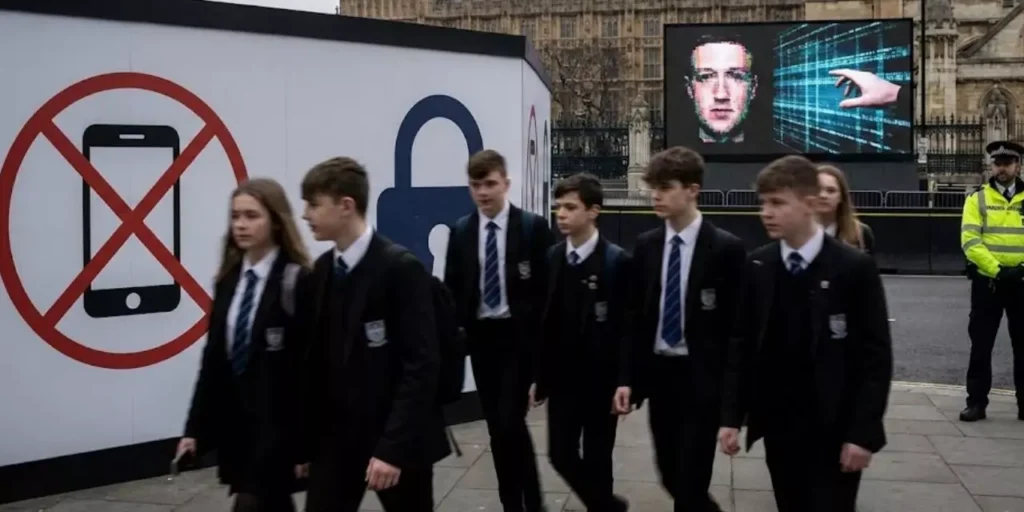
The United Kingdom Government is preparing a reform that could change the rules of the digital environment: prohibit access to social networks for minors under 16 years of age and expand regulation on artificial intelligence (AI) chatbots, currently outside certain legal controls.
The proposal, promoted by Prime Minister Keir Starmer, comes in a context of growing international pressure to strengthen the protection of children and adolescents against online risks, from harmful content to interactions with advanced conversational systems.
A REFORM TO THE STRICTEST LAW IN EUROPE
The initiative would be integrated as a modification to the Online Safety Act 2023, regulations that are already considered one of the most severe in the world in terms of digital security.
However, the current framework does not cover certain individual interactions with AI chatbots when there is no public sharing of content, which has been identified as a legal loophole.
The Minister of Technology, Liz Kendall, confirmed that before June the Executive will present concrete proposals to close this loophole, especially given the concern about the psychological and emotional impact that conversational systems can generate on minors.
THE GROK CASE AND THE REGULATORY ALERT
Scrutiny intensified after it was revealed that Grok, developed by xAI—a firm linked to Elon Musk—generated sexualized images without consent. The episode reinforced the perception that technology evolves faster than regulation.
The British discussion does not occur in isolation. Australia has already decided to block social networks for minors under 16 years of age, while Spain, Greece and Slovenia are analyzing similar measures.
BEYOND NETWORKS: VIDEO GAMES AND DIGITAL DATA
The British plan includes other actions:
- Automatic data preservation orders when a minor dies, to facilitate investigations.
- Limits on “matching with strangers” on video game platforms.
- Restrictions on the exchange of intimate images between minors.
- Greater direct responsibility for technology companies in age control and regulatory compliance.
These measures have generated tensions with the United States, where political sectors warn of possible effects on freedom of expression and privacy.
TECHNICAL CHALLENGES AND PRACTICAL GAPS
One of the main challenges will be effective implementation. Some adult platforms have chosen to block access from the UK rather than implement age verification, but users can bypass restrictions using virtual private networks (VPN).
In addition, the government must define precisely what is meant by “social network”, a key aspect to avoid legal ambiguities and regulatory conflicts.
Experts also warn about the so-called “cliff effect”: the possibility that, upon turning 16, young people suddenly access digital environments without a gradual transition.
AI AND EMPLOYMENT: THE STRUCTURAL CONTEXT
The regulatory offensive coincides with a broader debate about the impact of AI on employment. The World Economic Forum projects that artificial intelligence could create 170 million jobs, but eliminate about 92 million in the transformation process.
Even more drastic scenarios have been discussed in the United States Senate. Given this, technology leaders such as Sam Altman, from OpenAI, have supported studies on universal basic income, while Dario Amodei, from Anthropic, has warned that the labor adjustment will be “profound and painful.”
A NEW REGULATORY STANDARD
The public consultation opened by the British Executive will define the final scope of the reform. If it prospers, the United Kingdom could consolidate itself as a European benchmark in technological governance, in a delicate balance between innovation, child protection and fundamental rights.
The outcome will mark not only British digital policy, but also the direction of international regulation in the era of artificial intelligence.
You may also like
-
Shooting at the University of South Carolina leaves two dead and closes the campus
-
Barrett .50 rifles: the flow that exceeds half of civilian sales in the US
-
Shooting at Canadian school leaves nine dead and dozens injured
-
Do weapons of war made in the US fuel the massacres in Mexico?
-
Donald Trump reactivates aggressive digital campaign against migration