
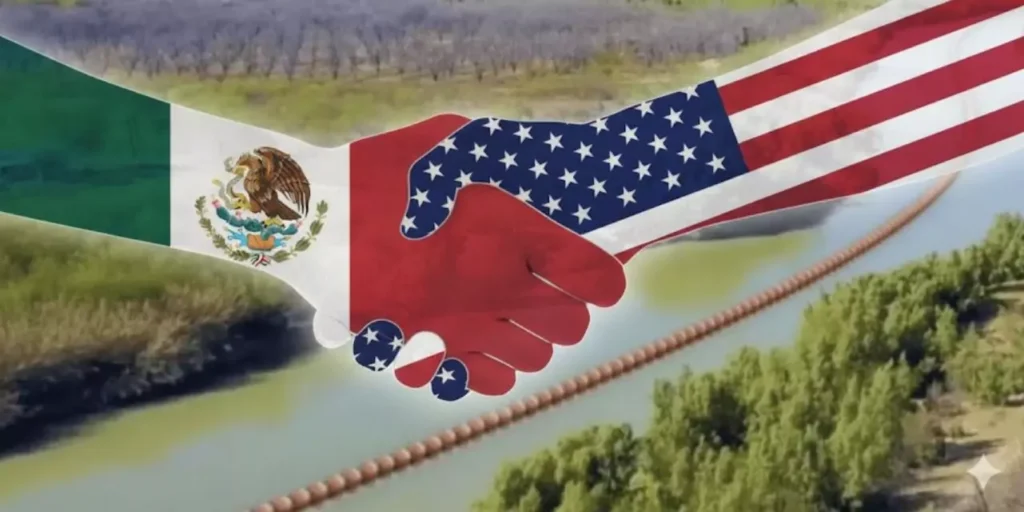
Within the framework of the 1944 Water Treaty, the governments of Mexico and the United States reached a technical agreement for water management in the Rio Grande basin, in a context of extreme drought that seriously affects the border region.
The plan establishes a clear compliance route in accordance with the mechanisms provided for in the treaty and is the result of sustained technical and political work, with full respect for the sovereignty of both countries. The agreement prioritizes at all times the human right to water and food, especially for Mexican communities.
MEXICO GUARANTEES MINIMUM WATER DELIVERIES
As part of the understanding, Mexico confirmed its willingness to guarantee a minimum annual delivery of 350,000 acre-feet of water (approximately 431,718,000 cubic meters) in accordance with the hydrological conditions of the basin and the provisions of the treaty. In addition, supply for human consumption and agricultural production were established as a priority, key sectors for the social and economic stability of the north of the country.
ORDERED MANAGEMENT AND LONG-TERM PLANNING
The agreement will strengthen the orderly management of water resources in the Rio Grande basin and move towards more predictable and responsible planning, in the face of the effects of climate change and prolonged drought.
The plan incorporates water infrastructure and long-term adaptation actions, under a shared responsibility scheme between both countries.
The Government of Mexico reaffirmed its commitment to the Water Treaty of 1944, considering it a key instrument to safeguard national interests and protect productive and agricultural activities in the territory.
RIO BRAVO CRISIS: DROUGHT, OVEREXPLOITATION AND POLLUTION
The Rio Grande faces an unprecedented multifactor crisis. The severe lack of rain has caused critical levels in strategic dams such as La Amistad and Falcón, while agricultural overexploitation and population growth exceed the natural availability of water.
Added to this is high pollution from wastewater discharges, pesticides, heavy metals and domestic waste, which deteriorates the ecosystem and affects the supply of drinking water.
In some areas, the river level has dropped to less than 30 centimeters, below the minimum necessary for its proper operation.
SOCIAL, ENVIRONMENTAL AND ECONOMIC IMPACTS
The Rio Grande water crisis has direct effects on daily life and the regional economy. Water scarcity affects agricultural production, increases binational tensions and puts the supply of millions of people on the border at risk.
Among the main consequences are:
- Economic losses in the agricultural and livestock sector
- Social and political conflicts over the distribution of water
- Greater humanitarian risk for migrants trying to cross the river
The new agreement between Mexico and the United States seeks to contain these impacts and lay the foundations for a more responsible and sustainable management of the water of the Rio Grande, in a region where access to the resource has become a strategic issue of security, development and international cooperation.
You may also like
-
Bad Bunny at the Super Bowl shakes Republican nerves and exposes political fractures over immigration
-
Waters with ICE! SRE alerts Mexicans who attend the Super Bowl due to possible immigration raids
-
Danone and Nestlé recall batches of infant milk due to contamination
-
The Legionaries of Christ elect Mexican Carlos Alberto Gutiérrez as General Director
-
Aeroméxico is once again the most punctual airline in the world in 2025, according to Cirium