The keys
nuevo
Generated with AI
nuevo
Generated with AI
The crisis of Greenland It achieved what almost nothing achieves in the EU: seamless unity and determination in the response. But the effect has barely survived a few days. It was enough that Donald Trump take a step back from its threats of military intervention and tariffs so that the Member States return to the usual divisions.
Fractures that have been revealed once again in the preparation of the informal meeting of heads of State and Government that is being held this Thursday at the Belgian castle of Alden Biesennear the border with the Netherlands.
The meeting was to serve to boost competitiveness and “break down the barriers that prevent us from being a true global giant” in economic matters, in the words of the president of the Commission, Ursula von der Leyen.
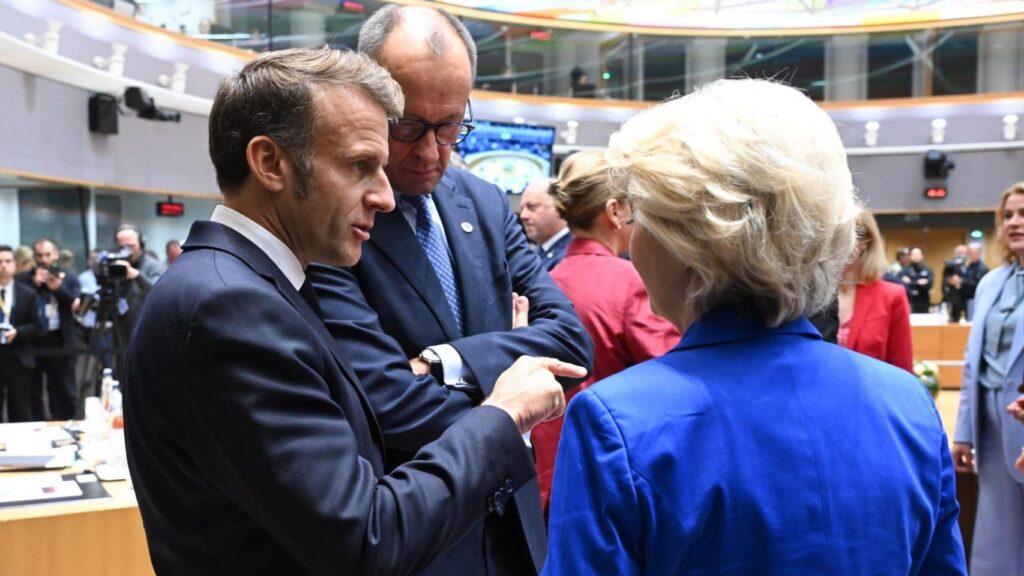
However, the clash between the French president, Emmanuel Macronand the German chancellor, Friedrich Merzhas seized the traditional Franco-German engine and once again hinders the aspirations for “independence” of the European Union in the face of the tariff war of Donald Trump and growing economic pressure from China.
“We have the Chinese tsunami on the trade front and, at the same time, minute-by-minute instability in the United States. These two crises represent a deep shocka break for Europeans”, Macron said in an interview with several European media.
But Merz has preferred this time to ally with the Italian prime minister, Giorgia Melonisigning a joint declaration with minimum proposals, which leave aside the more ambitious measures advocated by Macron, in particular a new issuance of Eurobonds.
Pressured by his internal problems and the controversy that his policy of regularizing migrants unleashed in the EU, the President of the Government, Pedro Sanchezhas remained practically absent in this debate, and, unlike other partners, has not provided any documents of its own.
In his interview, Macron maintains that “it is time for the EU to launch a common debt capacitythrough Eurobonds”—following the example of the Next Generation program—in order to finance investment in key sectors, starting with defense.
The French president further suggests that common debt could help challenge the hegemony of the US dollar. “In reality, the global market is increasingly distrustful of the greenback (…) It is looking for alternatives. Let’s offer you European debt“, he states.
A similar argument has been defended by the Minister of Economy, Carlos Bodyin an article published in the FT. “The bonds issued by the EU would attract long-term capital, reduce financing costs and unlock strategic autonomy,” he maintains.
“What is needed now are far-reaching structural reforms and, of course, completing the single market,” replied a senior German diplomat.
The other Paris proposal that has reopened old divisions in the EU is the clause Buy Europeanwhich consists of giving priority to European companies, products or services over competitors from outside the EU in certain strategic sectors or in public procurement.
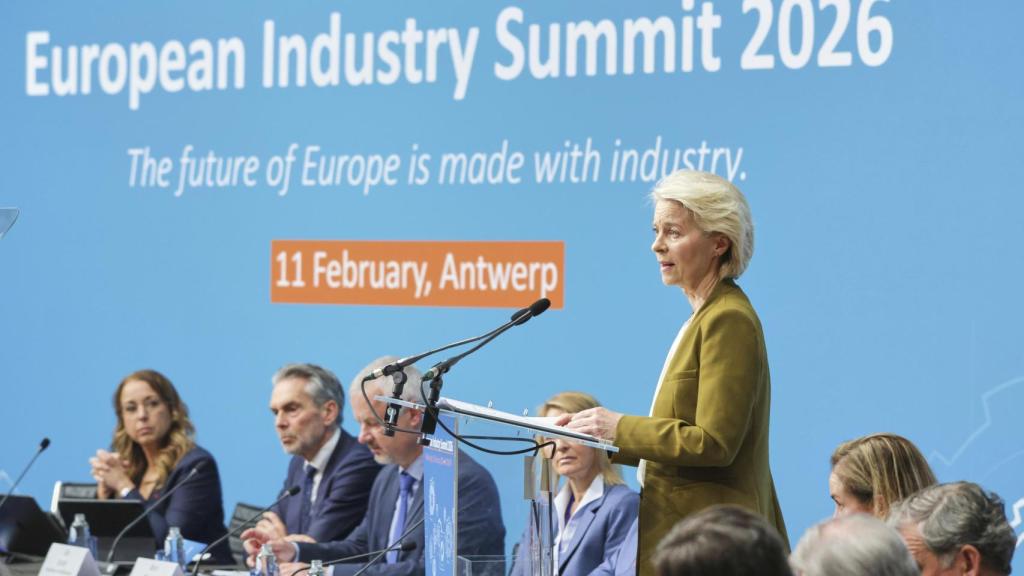
President Ursula von der Leyen, during her speech this Wednesday at an industrial forum in Antwerp
Netherlands, the Nordics and the Baltics have declared themselves “very skeptical” on the establishment of a European preference, as they consider it to be equivalent to a return to protectionism. Germany also has reservations about this initiative, although in this case it has opted for discretion.
“A general application of the European preference could nullify simplification efforts, make it difficult for companies to access world-class technologies, hinder exchange with other markets and divert investments away from the EU“says a joint statement signed by Sweden, Finland, the Netherlands, Latvia, Lithuania and Estonia.
“I believe that, in strategic sectors, European preference is a necessary instrument that will contribute to strengthening Europe’s own production base. It can help create leading markets in these sectors and support the expansion of European productive capacity,” Von der Leyen said in the European Parliament this Wednesday.
“But I want to be clear: It’s delicate terrain.. There is no “one size fits all” solution. Therefore, each proposal must be supported by a solid economic analysis and be aligned with our international obligations,” argues the president of the Commission.
As explained from Moncloa, Sánchez would be closer to the French president than to the German chancellor: defends the issuance of Eurobonds to boost public investment towards strategic EU objectives, as well as European preference in sectors such as low-carbon steel made in Spain.
The only recipe on which all Member States agree to improve competitiveness is deregulation and reduction of bureaucracy. Brussels has already presented ten legislative packages – the so-called “omnibuses” in Brussels jargon – aimed at simplifying community regulations, with an estimated saving for companies of 15 billion.
However, Von der Leyen insists that this effort must also extend to national laws. He gives concrete examples: a truck can weigh up to 44 tons in Belgium, but when crossing into France it is only allowed 40; some Member States still only accept correspondence by fax (he hasn’t said which ones).
Meanwhile, the ambitious project to channel European private savings into the real economy, the Capital Markets Unionremains paralyzed by the veto of small states such as Ireland or Luxembourg, which fear losing their privileged status as financial centers.
That is why the president of the Commission has opened the door to a Europe at various speedswith the formation of coalitions of volunteers who want to advance faster, overcoming the veto of those lagging behind. An idea that does have the support of France and Germany, but also of Spain, Italy, Poland and the Netherlands.
“Our companies need capital now. So let’s do it this year. My plan A is to move forward with the 27. But if it is not possible, the Treaty allows for enhanced cooperation,” Von der Leyen said.
You may also like
-
Iran celebrates the 47th anniversary of the revolution after arresting 5 reformist leaders critical of the repression of protests
-
The intrastory of the end of the Super League: the meeting between Florentino, Ceferin and Al-Khelaifi, the threat of the 4,000 million, the loneliness of Madrid…
-
Delcy Rodríguez commits to the US Secretary of Energy to have a “long-term productive partnership”
-
insults and criticism from Democrats and Republicans
-
Netanyahu tries to sabotage nuclear negotiations between Iran and the US but Trump assures they will continue