
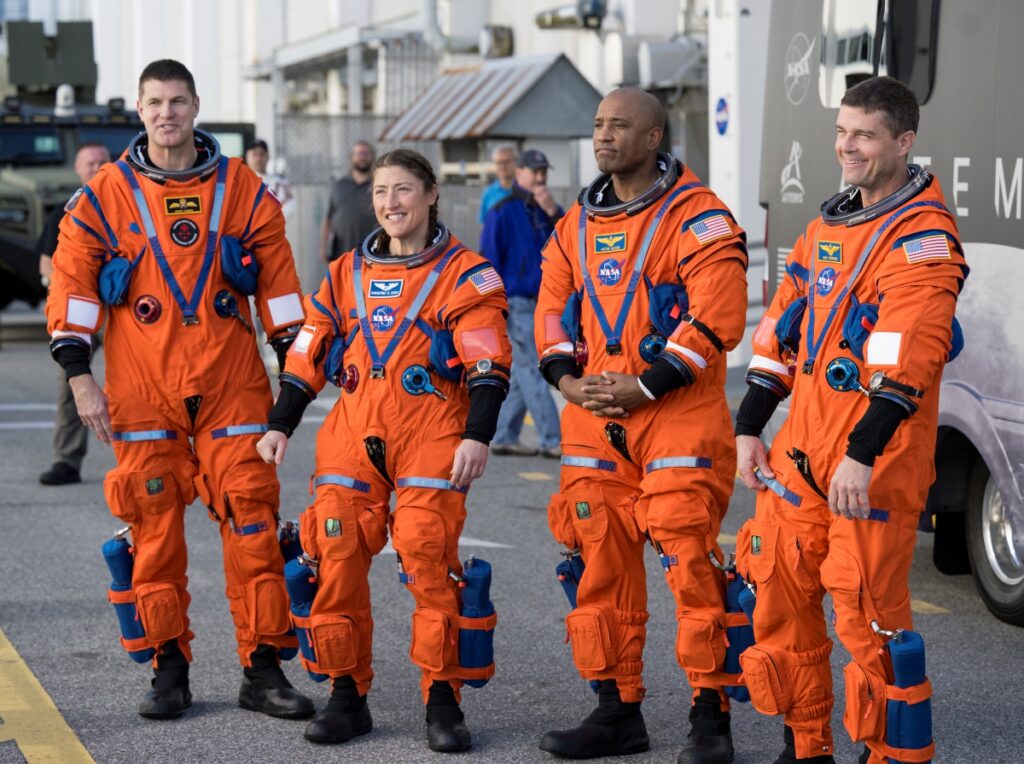
MIAMI (EFE).— The Artemis II mission will not only mark the return this year of humans to lunar orbit more than five decades after the last time, but it will also inaugurate a more representative era of exploration, by transferring a woman, an African-American man and a Canadian to the Earth’s satellite for the first time.
Along with the mission commander, the American Reid Wiseman, NASA specialists Christina Koch and Victor Glover, and Canadian Space Agency (CSA) astronaut Jeremy Hansen will travel.
The four have accumulated 661 days of experience in space and twelve walks outdoors, and will have the mission of reaching lunar orbit, surrounding the satellite and returning to Earth in ten days.
Last Friday the 23rd, the crew began the regulatory quarantine before the takeoff of Artemis II, whose launch window was modified yesterday due to bad weather in Florida, and now runs from Sunday, February 8 to next April.
The launch of Artemis II will mark humanity’s return to lunar orbit for the first time since 1972, when the members of the Apollo 12 mission left the surface of the satellite in the last of this type of exploration.
Artemis III, scheduled for after 2027, will be responsible for sending astronauts to the lunar surface again.
Koch, 47, is one of the two mission specialists, a role more focused on the execution of experiments and cargo logistics than in the case of the commander and pilot.
In addition to being the only woman on Artemis II, she is the astronaut with the most experience in space of the four crew members, thanks to the 328 consecutive days she spent on the International Space Station (ISS) between 2019 and 2020, an absolute record for a woman.
During that period, she carried out six space walks for a period of 42 hours and 15 minutes, including the first exclusively composed of women.
Born in Michigan, Koch was recruited as an astronaut in 2013 and Artemis II will give her the honor of being the first woman to travel to the Moon.
49-year-old pilot Victor Glover will become the first black person to reach lunar orbit.
He will be responsible for the flight systems of the Orion capsule, which will transport astronauts to lunar orbit, a role he already performed as pilot on SpaceX’s Crew-1 mission in 2018.
Designated an astronaut in 2013, this Californian is the second member of the mission with the most experience in space with 168 days.
In addition, he has completed four space walks and was chosen in 2023 by TIME magazine as one of the 100 emerging leaders for his technical skills and for his historic role as the first African American to travel to the Moon.
Like Wiseman, this will be his second space experience.
The first-time Canadian
Jeremy Hansen, born in Canada 50 years ago, is the only first-time member of the mission, since he has never left the Earth’s surface, despite serving as an astronaut since 2009.
He will be the first Canadian to reach lunar orbit when the Orion capsule approaches the Earth’s satellite.
However, Hansen has carried out missions in extreme environments in his training, living for a week straight underground or on the seabed within the framework of missions such as NEEMO, which has been used by NASA since 2001 to prepare astronauts for future space trips.
Wiseman, 50, the mission commander, was recruited as an astronaut in 2009 after more than 20 years of experience in the Navy. His first trip to space occurred five years later, when he spent 165 days aboard the space station.
Born in Baltimore, the astronaut performed two spacewalks during that mission, accumulating 13 hours outside the orbital laboratory.
Inside the station he established a milestone along with his other two colleagues in terms of research. The trio logged a record 82 hours of research in a single week in July 2014. Artemis II will be their second trip to space.
They will launch Crew-12
On the other hand, NASA plans to launch the Crew-12 manned mission to the International Space Station (ISS) on February 11 to replace the team that had to return to Earth a month earlier than planned due to the illness of one of its members.
The mission, which had initially been announced for February 15, will travel aboard a SpaceX Dragon capsule with a crew made up of Americans Jessica Meir and Jack Hathaway, Frenchwoman Sophie Adenot and Russian Andrey Fedyaev.
In a press conference, the four crew members were excited about the fact that they will coincide in space with the crew of the Artemis II.
“We are right on the verge of launching the Artemis II mission, and the fact that they are in space at the same time as us is something incredible (…). It’s really great to be an astronaut right now,” said Jessica Meir.
“Continuing with some of these experiments (on the ISS), which will help us in our first lunar landing missions, makes everything even more valuable and rewarding for us,” added the crew member.
The quartet will carry out a longer mission than usual, with an estimated duration of 9 months, instead of the usual six.
The launch window opens on February 11 with a scheduled liftoff from Cape Canaveral, Florida.
The four crew members will replace Crew-11, made up of Americans Zena Cardman and Mike Fincke, Japanese Kimiya Yui and Russian Oleg Platonov, who returned to Earth on January 14, in what became the first medical evacuation in the history of the ISS after a health problem was detected in one of its members.
NASA has not released the identity of the affected crew member for medical privacy reasons.
Since then, the station has been operated by a reduced crew: American Chris Williams and cosmonauts Sergey Kud-Sverchkov and Sergei Mikaev, who have kept operations and scientific experiments ongoing.
The launch of Crew-12 is part of a week of intense space activity for the United States.
With Crew-12 and Artemis II on the immediate schedule, NASA reinforces both the continuity of operations in Earth orbit and its exploration plans beyond Earth.
“We are all very excited about the launch of Artemis (…). The really cool thing is that, if we launch before Artemis, we will be on board the International Space Station, and part of its flight plan includes a call to the ISS,” said Meir.
The astronaut and her three companions began their two-week quarantine at NASA’s Johnson Space Center in Houston on Wednesday.
The idea is to reduce illnesses before the flight and prevent the appearance of symptoms during the mission.
During quarantine, contact with other people is limited and most interactions are done remotely. Family members and key mission personnel must undergo medical evaluations and be cleared before interacting with the Crew-12 crew.
Mission Reprogramming
NASA postponed the Artemis II takeoff window to February 8 due to the unusual cold.
Climate
An arctic blast in Florida forced the schedule to change; Bad weather prevents refueling as planned.
Postponed launch
NASA moved the supply to Monday, February 2 and ruled out Friday the 6th and Saturday the 7th for takeoff, which would be the 8th.
Historical mission
Artemis II will carry the first woman, first African American and first Canadian into lunar orbit, from which they will return in ten days.
Members
The crew of Artemis II are Commander Reid Wiseman, specialists Christina Koch and Victor Glover, and Canadian Jeremy Hansen.
Related
You may also like
-
The artificial intelligence that could end apps and subscriptions
-
Netflix revolutionizes: New app with vertical videos, already in testing!
-
Samsung Galaxy S26 Ultra leaked!: See the real photos and discover its release date
-
iPhone 18 Pro: Leaks reveal a design focused on power
-
YouTube transforms: CEO reveals “AI Slop” problems and promises solutions